Month: May 2026

A group of people standing and in wheelchairs all smiling and cheering together. Some have medals around their necks. They all belong to the West Dunbartonshire Boccia Club.

Spotlight On West Dunbartonshire’s Boccia Club

By William Moncrieff, SDS Communications Officer 


In the west of Scotland, one boccia club is showcasing the power of sport, and the impact it can have on participants’ mental health. West Dunbartonshire Boccia Club are using boccia as a tool to bring individuals together in a social, fun and inclusive setting which provides many benefits.  

Throughout the club’s work, participants are being impacted by sport in many ways. One of the things that the boccia club prides themselves on is the fun environment that they create for all participants and coaches. Alistair, aged 27, is one of the clubs abled bodied members and has noticed the mental and emotional impact that the club has on participants. He said: “The club is an incredibly friendly environment and provides participants plenty of opportunities to take part. I enjoy how happy everyone is throughout the game.” 

Jackie, aged 73, is another club member. He grew up with cerebral palsy and recently had a heart attack. Getting involved in the club and being active has had a positive impact on Jackie. He shared: “My mental health took a massive dip when I had my heart attack and by continuing with boccia it has allowed me to keep the friendships I have developed. The club is so warm and inviting and full of fun. It makes you forget the negative thoughts.” 

Andrew, aged 38, has a learning disability and has found himself to have been positively impacted by boccia, always looking forward to the sessions. He said, “I am very happy playing boccia. 10 out of 10 from me.”  

Andrew’s mum, Elaine, has taken a huge amount of enjoyment from watching Andrew participate in and grow through boccia. She commented: “As Andrew’s mum I can see how happy he is at boccia. It is not only playing that he enjoys but the meeting of new people. Boccia is a safe and stimulating environment. It’s fun and helps focus your mind.” 

Alistair originally joined the club so that he could spend more time with Andrew, his brother. Since joining the club, Alistair has been able to experience first-hand the positive impact the club and sport can have, along with being able to see the impact it has on those closest to him. “I love taking part in boccia with my brother, I love to see how happy he is playing,” Alistair said. 

Playing boccia has man benefits, including physical. This is something that Jackie has found to be important to him. “My biggest change is confidence in my fitness. Boccia helps with any level of fitness, and it makes such a difference,” he said. 

To ensure that all members have plenty of opportunities to spend time together and socialise, they have a break halfway through the session. This social time is something that Andrew really enjoys, commenting: “I love having my coffee and sometimes cake. I can chat to my friends and find out what is going on in the community.” 

Starting at the club as a participant and experiencing the impact it can have, Alistair has decided to become a volunteer at West Dumbartonshire Boccia Club. One of his favorite elements of volunteering is the feeling of serving the community around him. He said, “It gives me joy knowing that I am giving something back to my community.” 

Perhaps the most impactful element of boccia which makes it so special is its inclusivity.  

“Boccia is the most inclusive group I have come across. You can alter the play to fit any individual,” Jackie said. 


To get involved in boccia, please contact SDS’s Boccia Development Officer: jonathan.kennedy@scottishdisabilitysport.com

To keep up to date on all things disability sport across Scotland, follow Scottish Disability Sport on FacebookInstagram and LinkedIn

You may also like –

Members of the young persons' sports panel and young start programme pose together for the camera at Inverclyde National Sports Centre.

YPSP on Mental Health Awareness Week

This week is Mental Health Awareness Week, and I have been talking to members of the SDS Young Persons’ Sports Panel about what mental health means to them.

The SDS YPSP is a group of 15 disabled young people who are committed and enthusiastic about disability sport. In our monthly meetings we discuss a wide range of topics, from events and inclusive sports to raising awareness and social media. Since Mental Health Awareness Week is the 11th to 17th of May, I thought it timely to chat about the importance of mental health awareness and acceptance.

When asked what mental health meant to them, the panel had some really insightful answers. “Keeping things positive and trying not to let things get on top of you,” said Calum, highlighting the importance of stress and mental health. When you have a lot of possibly tricky things happening in your life, it’s important to find ways to cope before the stress becomes overwhelming. “Do you want to focus on the negatives or the positives?” asked peer mentor, Caitlyn.

Another key insight from the group was that mental health effects everybody in many different ways. It can be about dealing with a mental health condition but also keeping positive in everyday life. As Hollie described, “it’s not just the bad bits but the good bits too and everything in the middle!”

The theme of this week, from the Mental Health Foundation (MHF), is taking action for yourself, for someone else, and for all of us. Through our discussions, we found that sport plays a crucial role in both personal mental health and helping others. Peer mentor Ross said it was important to “focus on yourself for a wee bit each day.” All the panel members agreed that their sport helped them to feel better. “If I’ve got something on my mind I’ll do my swimming” said Ruby. Calum also agreed, saying, “I go out for a run and write my feelings down.”

We also talked about the impact sport can have your mental health when it’s not going so smoothly. Calum talked about the pressure of competing and how he focuses on not burning himself out so much. I also believe that it is important to remember why you love your sport and make sure to protect that joy. Volunteering is a great way to do this, with Millie Boo saying, “it can be so rewarding for mental health.”

With many of our panel members volunteering in disability sport, we discussed what actions we can take to help the mental health of others too. “Give them time to talk to you or let them know you are there,” said Ruby, adding that she spreads encouragement and positivity to participants. You can never know what someone else is going through, so you should always be aware of how your actions can impact someone’s mental health.

This Mental Health Awareness Week, the MHF invites you to reflect on your actions for mental health, as we build “communities of motivated people [who] are laying the

foundations for a society that prioritises good mental health.” Whether you act for yourself of others, “it shows it’s okay not to be okay and no one is alone,” as Millie Boo told me. This is action at its most powerful.


Scottish Disability Sport are currently recruiting for the next intake of our Young Persons’ Sports Panel and Young Start coaching programmes. Applications for both programmes close on 22nd May 2026. To apply or find out more information, please visit: Young Start and Young Persons’ Sports Panel –

Paralympian Stephen MacGuire and Great Britain’s wheelchair rugby athlete Gemma Lumsdaine, head the Scottish Parliamentary photocall on the stairs inside the Scottish Parliament. MSP gather on the stairs with a selection holding sporting equipment (boccia balls, football, tennis racquet, basketball) whilst others hold signs pledging support for the SDS Call to Action.

Break the Barrier: Scotland’s 2026 Manifestos

Break the Barrier: What Scotland’s 2026 manifestos mean for disability sport (and why it matters now)

By Mark Gaffney, Head of Policy, Scottish Disability Sport

Yesterday, I covered why making Scotland more inclusive and accessible is the right thing to do if we want to improve our nation’s health outcomes. Today we look at each of the main political parties in Scotland and what their manifestos are saying about their commitment to action.

For a wider take on how sport is covered in the party manifestos I would thoroughly recommend Malcolm Dingwall Smith’s insightful pieces reviewing each of the major parties and their commitment to action on sport.

The detail below will be more related to how each party intends to improve the lives of those with a disability. If we’re serious about health, education, social care, and equality, diversity and inclusion (EDI), then we have to be serious about disability sport and physical activity—not as an add‑on, but as a system outcome.

Scottish Disability Sport’s Call to Action is built on lived experience and evidence. It shows a profound participation gap: over 90% of disabled respondents do not meet recommended physical activity levels, even though 95% believe being active benefits their mental health and wellbeing. People aren’t opting out; they’re being locked out—by affordability, transport, inaccessible facilities, inconsistent support across systems, and fear that being active could jeopardise financial support.

SDS’ message to every party is clear: inclusion is a rights issue under UNCRPD Article 30, and it requires cross‑government delivery (sport, health, education, local government, social care, transport and EDI working together).

Below is an SDS‑lens summary of what the major parties’ 2026 Scottish manifestos offer—and our take on what needs strengthened.

Overall, it would be fair to say that sport is not a strong theme throughout and suffers in comparison to other areas such as Culture which sees a continuation and extension of funding levels to the tune of £100m with a further £50m uplift within 5 years. With green shoots of progress being seen in sport speaking as a collective voice, then this should be the least the sector aspires to. It also should be said that politicians need to absolutely do their bit too and commit to promises that were made. The doubling of the sports budget that was promised in the last government didn’t ever materialise, despite the welcome £40m uplift following the last budget. Figures can often be misleading and much of that £40m uplift is one-off funding – which will undoubtedly do good – but doesn’t ultimately give people the best chance to sustain, consolidate and develop impact over time.


What the parties are saying (through a disability sport lens)

Let’s start with the party that has been in power for nearly twenty years. The Scottish National Party (SNP) are the outgoing government and all up to date polling would suggest that they are set to continue to be the largest party at Holyrood – although, they may ultimately fall short of the majority that John Swinney would want. Whether a coalition is formed with another pro-independence party (i.e. the Greens) remains to be seen.


SNP: big on cost of living and NHS. Sport needs to be named, funded, and measured.

With an obvious overarching fundamental push for independence, the SNP manifesto launch messaging cites 50 steps it will take which features amongst them

  • a commitment to extra help with cost of living
  • new school breakfast clubs
  • summer of sport
  • public sector reform
  • increased Additional Support Needs support.

There is a clear focus on tackling the cost of living and commitment to the NHS access with some commitment to a preventative approach through early intervention and prioritising self-management of care through a new app.

The usual hallmarks of an SNP administration are there with state-led support for university fees, prescriptions, school meals, dental and eye checks and winter payments for families with disabled children offset by higher tax rates for the highest earners – caveated by their contention of the “fairest and most progressive tax system in the UK”.

Continuing their aims of eradicating child poverty, the SNP will maintain the Scottish Child Payment and introduce Bright Start Breakfasts across all primary and special schools – ensuring a healthy start to the day for kids with breakfast and play amongst friends.

Further to this a Digital Inclusion Action Plan and a promise to tackle the cost of disability with the much sought after third-sector support for multi-year settlements for Disabled People’s Organisations (which ones exactly, we do not know but likely to be connected to the delivery of the Disability Equality Plan – £2.5m of additional investment) and a Transition to Adulthood Guarantee for all young people with disabilities.

Returning to healthcare now, the promises of investment in the NHS are evident with a community-care theme emerging throughout. Chest, Heart and Stroke Scotland will benefit to the tune of an initial £1m to support the expansion of new stroke rehabilitation gyms. There is a further commitment to work with people with lived experience to develop a long-term conditions framework with detail, again, a bit light.

In the SNP manifesto sport sits within the healthcare portfolio and is framed with a focus on international events, citing an exciting summer of sport ahead and the £40m of new investment. There is new Sports Taster Fund with boccia – and Scottish Disability Sport – one of the lucky few sports explicitly referenced. Free swimming lessons for every primary school child is highlighted with a commitment to statutory consultation with sportscotland and Scottish Swimming for every pool under threat of closure.

Further relevant commitments

  • Any child with additional support needs will be supported through specialised ASN provision in school – regardless of where they go to school.
  • Behaviour specialist teachers supporting schools
  • Development teacher training specifically designed for teaching in special schools.
  • BSL training for teachers with a pool of specialist deafblind teachers
  • Bespoke employment apprenticeship scheme for young people with disabilities

SDS View: Sport appears important to the SNP particularly through a health and communities context. It is positive that SDS is explicitly referenced which shows disability sport is on the radar. The test is whether disability sport is treated as a system outcome—through proportionate funding, accessible facilities and travel, workforce training, and a consistent health/social care referral offer—not simply as a positive aspiration. The cross-portfolio work with Equalities and the Disability Action Plan will engender positive outcomes.


Scottish Greens: the most explicit disability sport platform

The Greens are the clearest in naming barriers SDS hears daily—lack of facilities/greenspace, prohibitive costs, and poor public transport—and treating sport as a wellbeing investment. Their manifesto includes commitments that map directly onto SDS’ Call to Action, including:

  • Real‑terms, multi‑year funding for sport/active living organisations (stability matters for inclusion delivery).
  • Protecting and requiring accessible, affordable, fit‑for‑purpose facilities through planning decisions.
  • Widening access for disabled people and embedding disabled sport knowledge in public health and leisure settings—high alignment with our whole‑system ask.
  • Children’s Sports Card: affordable access to sport and recreational activities
  • A commitment to enhance support to disabled Scots and their carers and implementing recommendations of the Independent Review on Adult Disability Payment including scrapping the inhumane 20m rule
  • Inclusive communication approaches across public bodies and services

Their “Disabled people” chapter also commits to incorporating the UN Convention on the Rights of Disabled People into Scots law and requiring Disabled People’s Organisations’ involvement in planning infrastructure—both highly relevant to inclusive facilities and services.

SDS View: strongest “what” on paper; delivery will depend on sustained investment and local implementation capacity. There is a strong commitment, as you might expect, to places and spaces being inclusive.


Scottish Labour: strong health/care reform story—sport must be hard‑wired into it

Labour’s manifesto is framed around NHS access, workforce reform, and tackling delayed discharge, including neighbourhood health hubs that co‑locate general practice with community health, physiotherapy and social care. This is a major opportunity for disability sport if we choose to use it: SDS is explicitly calling for “a health and social care system that prescribes appropriate physical activity opportunities at every stage of the individual’s pathway.”

Labour also highlights support around transitions into work and improving access to services—important in a landscape where disabled people fear being penalised for being active.

SDS View: disability sport is not consistently named as a deliverable outcome. The risk is “health reform without prevention pathways”—and physical activity becomes assumed rather than commissioned, referred, and measured.


Scottish Liberal Democrats: carers and community healthcare—missing a clear inclusion pathway into sport

The Liberal Democrats foreground faster access to care, long‑term workforce planning, and tackling delayed discharge—explicitly acknowledging that you can’t fix the NHS without fixing care. This aligns with SDS’ view that disability sport is part of prevention and independence, not an optional extra.

Their manifesto also highlights support for carers and improving services for people facing barriers—including disability employment gap ambitions—which matters because carers and social support networks are often the enablers of participation.

There is a strong ASN commitment in education through staffing and support and robust social care investment.

SDS View: as with several parties, there is no clearly defined “referral‑to‑community sport” pathway (health – social care – leisure trusts/clubs) with inclusion training and accountability. Without that, provision remains patchy and postcode‑dependent.


Scottish Conservatives: efficiency and reform—real risks for EDI capability and inclusive delivery

The Conservatives’ manifesto is driven by public sector reform and cost‑cutting, including reducing public bodies and reporting burdens. But one section is particularly concerning from an SDS inclusion perspective: it proposes banning public sector roles devoted exclusively to diversity, equality and inclusion.

Why this matters: SDS’ Call to Action requires disability inclusion training, inclusive communication, culture change, and partnership working across systems. That capability doesn’t appear by magic—it is built and maintained. Removing specialist inclusion infrastructure without replacing it with a robust, enforceable alternative risks weakening delivery at precisely the point we need it most.

SDS view: if “efficiency” becomes a proxy for stripping inclusion capacity, we will widen inequalities—especially in local services where disability sport opportunities depend on trained staff and accessible systems.


Reform UK (Scotland): economy-first, “welfare” reform, and cultural framing—major inclusion risks unless safeguards are explicit

Reform’s Scotland manifesto is explicit about its framing: it argues Scotland must reduce a perceived “work to welfare” imbalance, and it positions welfare as a “safety net, not a lifestyle choice.” It proposes tax reform and a broad “new economy” approach, and it criticises what it describes as “woke policies” in areas including immigration and gender.

On health, Reform says the NHS will remain free at the point of need but “needs reform,” and it links NHS performance problems to delayed discharge and system productivity.

SDS view: the Reform manifesto does not set out a clear disability sport or inclusive activity pathway, and its welfare rhetoric creates a clear risk against SDS’ evidence base unless counterbalanced by explicit safeguards. SDS’ survey found 40% fear losing financial support if they are seen to be more active, and our Call to Action demands government reassurance that being active will not negatively affect support. Any approach that increases conditionality, distrust, or fear—without crystal‑clear protections—could further suppress participation and worsen health inequalities.

This is not a theoretical concern. It is what disabled people told us, directly, in Scotland.


What we need next: a cross‑government “inclusion delivery deal”

Regardless of who forms the next Government, SDS is calling for a practical delivery package that connects health, education, social care, transport, and sport:

  1. Physical activity as a core part of health and care pathways: Build referral routes so every disabled person can access appropriate activity opportunities at every stage of their pathway—as the Call to Action sets out.
  2. Benefits reassurance that removes fear: Put safeguards in policy, communications and practice so disabled people can be active without worrying that visibility equals penalty.
  3. Self‑Directed Support that works consistently for sport and activity: End local variability and ensure SDS budgets can fund participation reliably.
  4. Accessible transport and facilities as enabling infrastructure: Investment, planning rules and local delivery must remove barriers around travel and inclusive spaces.
  5. Workforce training and inclusion capability: Inclusive delivery requires trained people and accountable systems—not just warm words.


Final thought

This election sits inside a wider national moment. SDS has deliberately positioned the period from the election through to Glasgow 2026 as the time to “reignite the conversation” and demand systemic change.

Disabled people are telling us they want to be more active—but they need Scotland to build access, not just celebrate inspiration.

If you’re an MSP candidate, policymaker, health leader, local authority, leisure trust, or sport organisation: let’s align around the Call to Action and commit to delivery that crosses the usual boundaries.


Links (for readers)


Photo of Layla McCloskey smiling as she is on her frame runner. Her frame is red as well as her helmet. She has a light blue hoodie on.

A Call to Action Scotland Cannot Ignore

A Call to Action Scotland Cannot Ignore: Making Sport and Physical Activity a Right for People with disabilities.

By Mark Gaffney, Head of Policy at Scottish Disability Sport

As Scotland approaches another pivotal election on Thursday, we are rightly focused on the kind of country we want to be. One that values fairness, equality of opportunity and wellbeing for ALL our people; or one that continues to accept deep and preventable inequalities as inevitable. Nowhere is that choice clearer than in sport and physical activity for people with disabilities.

Sport and physical activity can be a source of joy, connection and lifelong health. Yet for thousands of people with disabilities across Scotland, it remains out of reach. Countless studies – including our own National Survey – show that people with disabilities are significantly less likely to be active than non‑disabled people, not because of a lack of interest or talent, but because of structural barriers that persist year after year. These barriers are not accidental. They are the product of policy and strategy choices, funding decisions and accountability gaps. That is why Scottish Disability Sport (SDS) launched its Call to Action in September 2025 (following the findings from the first ever National Survey) and why it must be central to the next Scottish government’s priorities.

The benefits of sport and physical activity are well‑evidenced. They improve physical and mental health, reduce loneliness, strengthen communities and increase confidence and independence. For people with disabilities, these benefits can be transformative. Yet all too often people with disabilities face inaccessible facilities, a shortage of inclusive opportunities, inadequately equipped teachers and coaches in inclusive practice, limited transport options and patchy local provision – despite the fine efforts of the SDS Member Branches to support as many people (including, critically, adults with disabilities who are often overlooked when it comes to opportunities). These barriers compound wider inequalities in health, employment and social participation.

Scotland has no shortage of strong words or progressive intentions. Strategies on health, equality and inclusion repeatedly recognise the importance of physical activity – particularly for those least active if we want to start moving the dial on reducing inequalities in health to counter Scotland’s place as the “Sick Man of Europe” with the lowest life expectancy in Western Europe. However, people with disabilities have learned the hard way that recognition alone does not equal change. What is missing is consistent delivery, co‑design with people with disabilities, and long‑term commitment backed by proactive intentional change, resource and accountability.

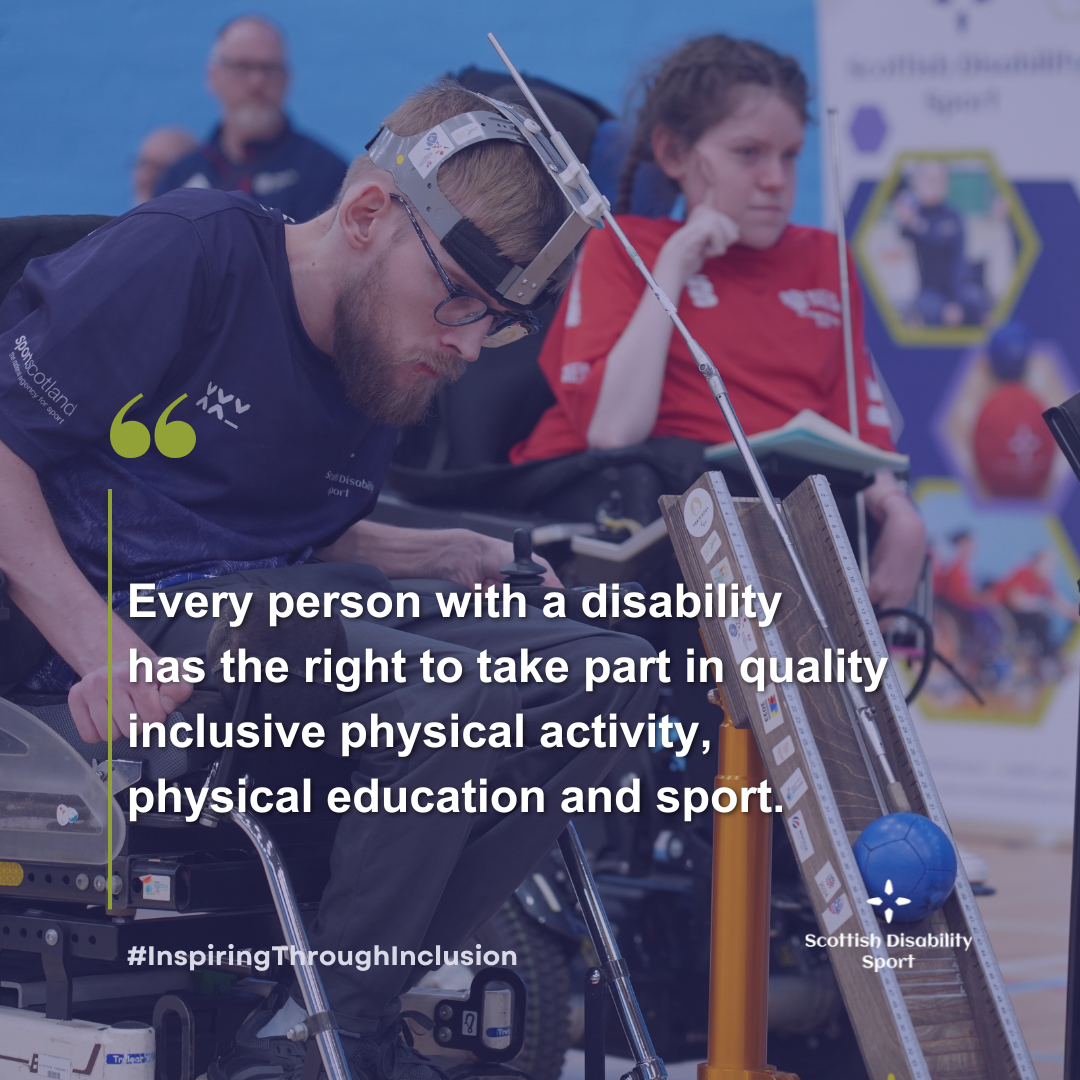
The SDS Call to Action sets out a practical, proactive and engaging framework to change this. At its core is a simple principle: People with disabilities must have the same right to be active as everyone else as laid out in the United Nations Convention on the Rights of People with Disabilities. This means embedding inclusion across the whole sporting and physical activity system, not treating it as an optional add‑on, a “nice to do” or a short‑term project.

First, we must address leadership and accountability.  Inclusion cannot sit on the margins of government portfolios or be passed between agencies and left to fall between the cracks. The next Scottish Government should clearly assign responsibility for people with disabilities’ access to sport and physical activity to the sector as a whole, with measurable outcomes and transparent reporting. Without this, inequalities will continue to fall through the cracks. It may be too optimistic at this juncture to ask for a Cabinet Secretary post in sport alone, but it shouldn’t be beyond the realms of reason for it to achieve a prominence alongside a complementary portfolio area such as Culture and for those incumbents to work with those in the Equalities portfolio amongst others to engender better outcomes for people with disabilities.

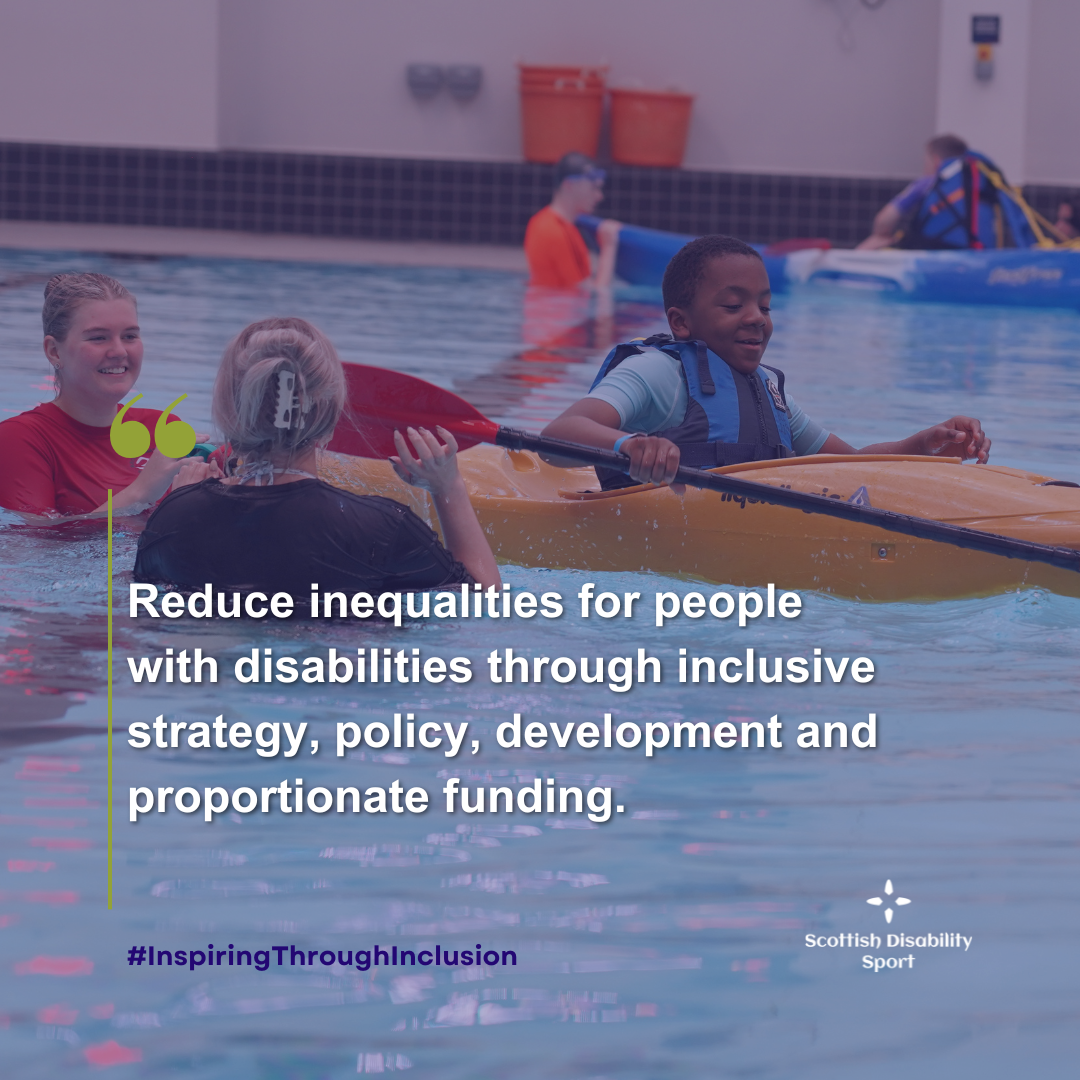
Investment matters. Inclusive provision costs money—whether that is adapting facilities, supporting specialist equipment, or ensuring clubs have the support they need to welcome disabled participants. Yet inclusive investment is not an additional luxury; it is a preventative measure that saves costs across health and social care in the long term. Funding models must recognise this and provide sustainable, multi‑year support, particularly at local and community level where impact is greatest.

People and skills are key. Teachers, coaches, volunteers and staff want to do the right thing, but many lack confidence or training in inclusive practice. A strengthened national approach to workforce development is essential, ensuring inclusion and disability awareness are core components, not optional extras. This is about empowering people to say “yes” rather than defaulting to exclusion through uncertainty.

If all our trainee PE teachers, Primary teachers and sports coaches are educated in inclusive practice at source then by extension the chances of a better experience for people with disabilities at school or within community activity suddenly look more hopeful. The same is true for health and social care. Inactivity should be treated with the same weight as other harms such as smoking, drugs, alcohol and poor diet and suitable and appropriate activity (not just gym referrals with are not appropriate for many) must be prescribed and facilitated at every stage of a person’s care journey. From there, clear pathways to lifelong, sustained engagement should be straightforward and supported. Links between education, healthcare, local authorities, governing bodies of sport and third sector need to be joined up and systemic.

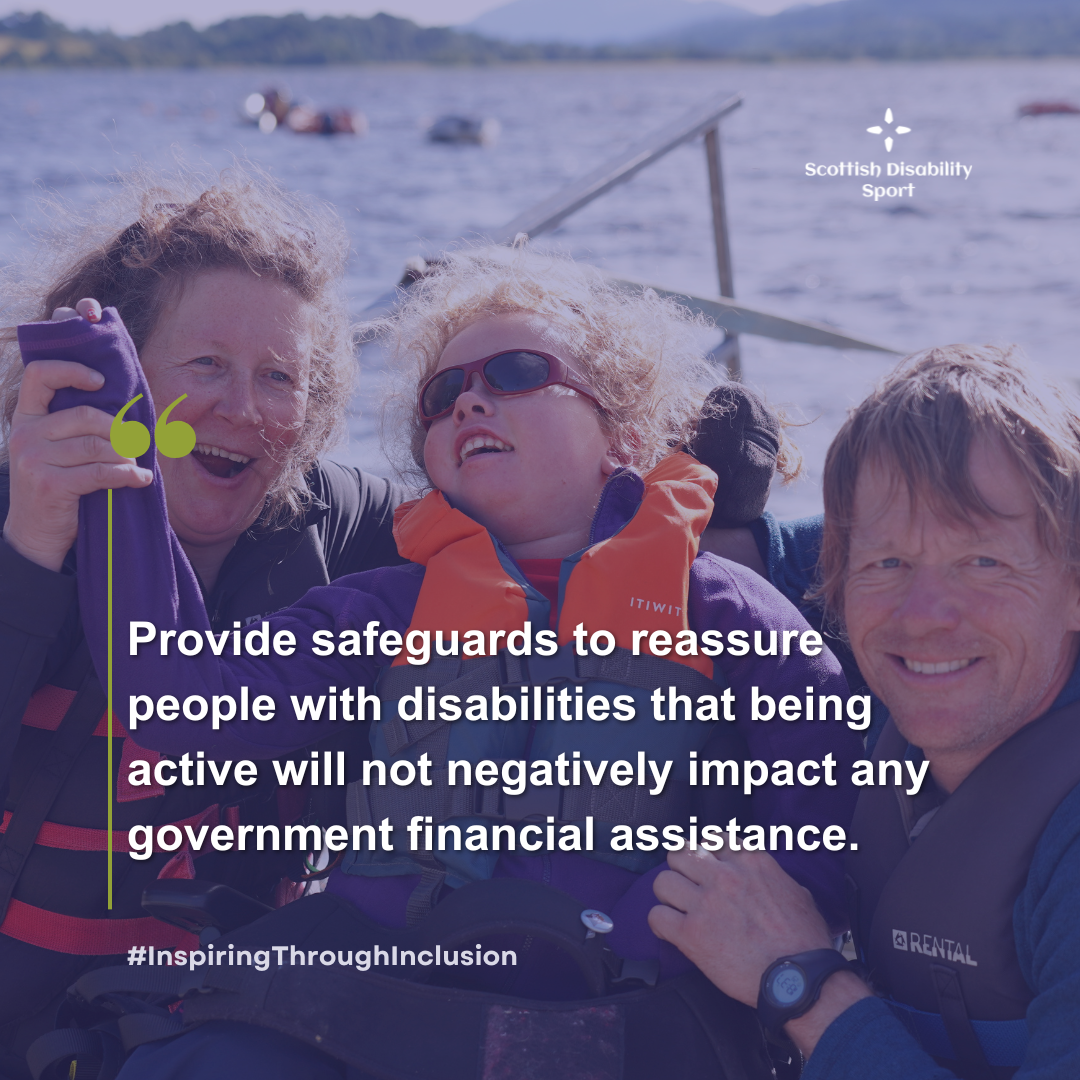
A major barrier that continues to be impactful for people with disabilities in Scotland is the lack of clear guidance and robust policy to reassure people with disabilities that being active will not affect their government financial support they rely on so heavily to just live. We are hearing anecdotally that the move from the UK system to Social Security System appears to have generally gone smoothly and on the face of it is a more compassionate and supportive system, however, more needs to be done to ensure people are not penalised for engaging in efforts to improve their health. Current benefit rules and systems can discourage participation and engagement in sport and physical activity. Although Self Directed Support is designed to prioritise choice and control, inconsistent implementation around accessing physical activity is limiting these choices. Physical activity should be seen as a critical and substantial need for individuals to allow them the freedom to pursue health and wellbeing gains. It has been proven that it can cost an average of £1100 a month more to have a disability than to not, clearly difficult choices need to be made for individuals for the most basic of needs before determining whether expensive sporting opportunities are accessible to them. This is why we back a mandated inclusive strategy where all bodies who receive any public funding ensure that they are accountable for providing affordable and accessible opportunities for people with disabilities and furthermore provide a discounted rate to participate.

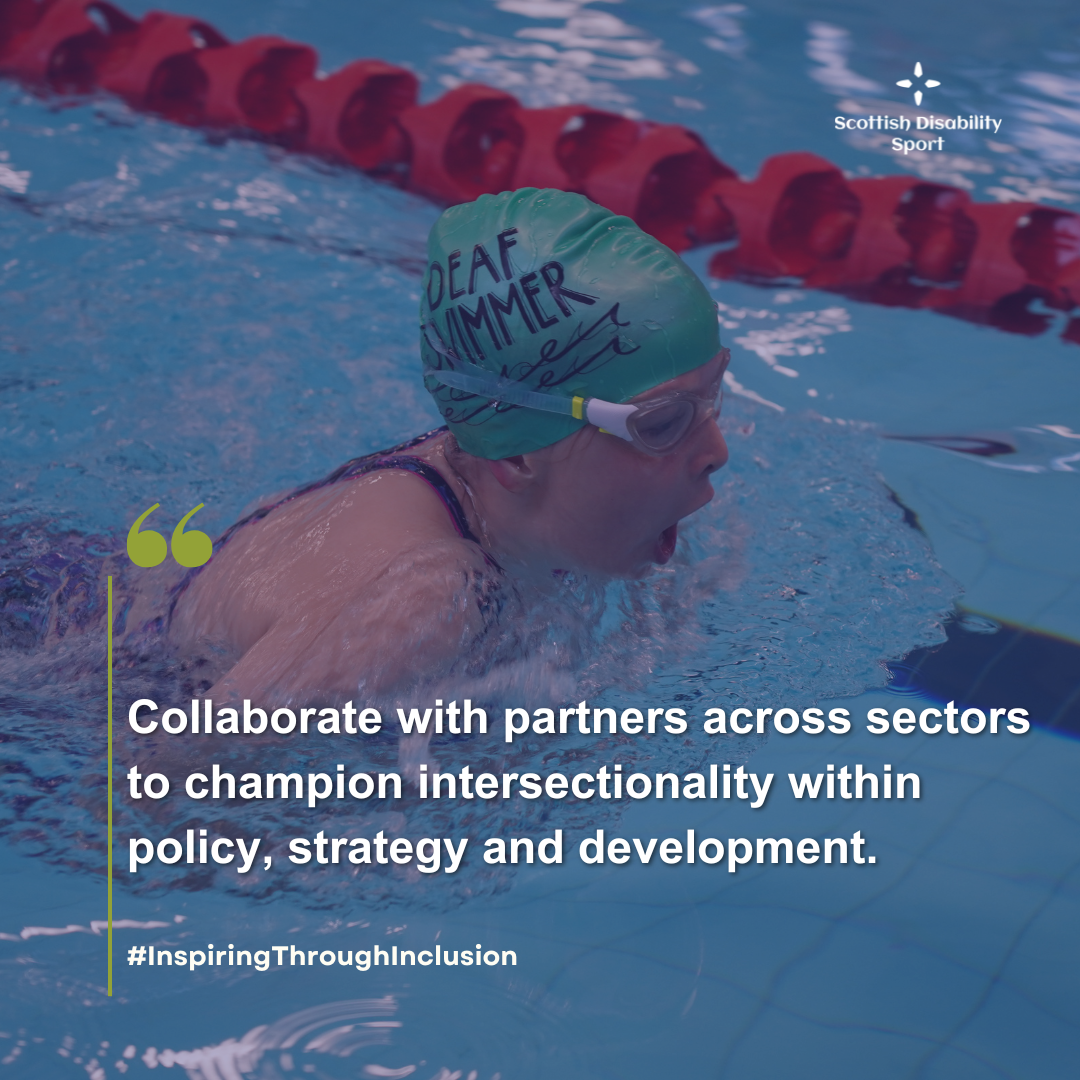
Finally, people with disabilities must be at the heart of decision‑making. Policies designed for People with disabilities too often fail because they are not designed with them. Co‑design is not a buzzword; it is a necessity. People with disabilities are experts in their own lives, and their voices must shape facilities, programmes and policy from the outset. At SDS we talk about taking an intersectional approach to inclusion. But what does this mean? Essentially, it means that we know that people are not made up of one characteristic alone, individuals have many identities – and these very identities can layer multiple and varied barriers to being active. One-size-fits-all approaches will often miss key needs. Collaboration with informed organisations, individuals and co-design will benefit future policy and planning.

This election presents a clear test. Parties across the political spectrum will talk about prevention, wellbeing and tackling health inequalities. The question is whether they are prepared to act when it comes to people with disabilities’ right to be active. Platitudes are not enough. What we need are clear pledges aligned with the SDS Call to Action, setting out how the next government will reduce barriers, close participation gaps and deliver lasting change.

Scotland has the talent, the evidence and the infrastructure to lead the way on inclusive sport. What has been lacking is the political will to treat this issue with the urgency it deserves. If we get this right, the rewards will be felt far beyond sports halls, playing fields and leisure centres—improving health, strengthening communities and affirming the value of people with disabilities’ participation in every aspect of Scottish life.

As voters prepare to make their choice, I urge them to ask a simple question of those seeking office: Will you turn inclusion into action? For People with disabilities across Scotland, the answer cannot be postponed any longer.

The SDS four-point Call to Action Graphics are available to download via the links below: 

Tomorrow, Mark will take us through a summary of each of the main party manifestos and what they mean for people with disabilities in Scotland.