Tag: SDS

Photo of Layla McCloskey smiling as she is on her frame runner. Her frame is red as well as her helmet. She has a light blue hoodie on.

A Call to Action Scotland Cannot Ignore

A Call to Action Scotland Cannot Ignore: Making Sport and Physical Activity a Right for People with disabilities.

By Mark Gaffney, Head of Policy at Scottish Disability Sport

As Scotland approaches another pivotal election on Thursday, we are rightly focused on the kind of country we want to be. One that values fairness, equality of opportunity and wellbeing for ALL our people; or one that continues to accept deep and preventable inequalities as inevitable. Nowhere is that choice clearer than in sport and physical activity for people with disabilities.

Sport and physical activity can be a source of joy, connection and lifelong health. Yet for thousands of people with disabilities across Scotland, it remains out of reach. Countless studies – including our own National Survey – show that people with disabilities are significantly less likely to be active than non‑disabled people, not because of a lack of interest or talent, but because of structural barriers that persist year after year. These barriers are not accidental. They are the product of policy and strategy choices, funding decisions and accountability gaps. That is why Scottish Disability Sport (SDS) launched its Call to Action in September 2025 (following the findings from the first ever National Survey) and why it must be central to the next Scottish government’s priorities.

The benefits of sport and physical activity are well‑evidenced. They improve physical and mental health, reduce loneliness, strengthen communities and increase confidence and independence. For people with disabilities, these benefits can be transformative. Yet all too often people with disabilities face inaccessible facilities, a shortage of inclusive opportunities, inadequately equipped teachers and coaches in inclusive practice, limited transport options and patchy local provision – despite the fine efforts of the SDS Member Branches to support as many people (including, critically, adults with disabilities who are often overlooked when it comes to opportunities). These barriers compound wider inequalities in health, employment and social participation.

Scotland has no shortage of strong words or progressive intentions. Strategies on health, equality and inclusion repeatedly recognise the importance of physical activity – particularly for those least active if we want to start moving the dial on reducing inequalities in health to counter Scotland’s place as the “Sick Man of Europe” with the lowest life expectancy in Western Europe. However, people with disabilities have learned the hard way that recognition alone does not equal change. What is missing is consistent delivery, co‑design with people with disabilities, and long‑term commitment backed by proactive intentional change, resource and accountability.

The SDS Call to Action sets out a practical, proactive and engaging framework to change this. At its core is a simple principle: People with disabilities must have the same right to be active as everyone else as laid out in the United Nations Convention on the Rights of People with Disabilities. This means embedding inclusion across the whole sporting and physical activity system, not treating it as an optional add‑on, a “nice to do” or a short‑term project.

First, we must address leadership and accountability.  Inclusion cannot sit on the margins of government portfolios or be passed between agencies and left to fall between the cracks. The next Scottish Government should clearly assign responsibility for people with disabilities’ access to sport and physical activity to the sector as a whole, with measurable outcomes and transparent reporting. Without this, inequalities will continue to fall through the cracks. It may be too optimistic at this juncture to ask for a Cabinet Secretary post in sport alone, but it shouldn’t be beyond the realms of reason for it to achieve a prominence alongside a complementary portfolio area such as Culture and for those incumbents to work with those in the Equalities portfolio amongst others to engender better outcomes for people with disabilities.

Investment matters. Inclusive provision costs money—whether that is adapting facilities, supporting specialist equipment, or ensuring clubs have the support they need to welcome disabled participants. Yet inclusive investment is not an additional luxury; it is a preventative measure that saves costs across health and social care in the long term. Funding models must recognise this and provide sustainable, multi‑year support, particularly at local and community level where impact is greatest.

People and skills are key. Teachers, coaches, volunteers and staff want to do the right thing, but many lack confidence or training in inclusive practice. A strengthened national approach to workforce development is essential, ensuring inclusion and disability awareness are core components, not optional extras. This is about empowering people to say “yes” rather than defaulting to exclusion through uncertainty.

If all our trainee PE teachers, Primary teachers and sports coaches are educated in inclusive practice at source then by extension the chances of a better experience for people with disabilities at school or within community activity suddenly look more hopeful. The same is true for health and social care. Inactivity should be treated with the same weight as other harms such as smoking, drugs, alcohol and poor diet and suitable and appropriate activity (not just gym referrals with are not appropriate for many) must be prescribed and facilitated at every stage of a person’s care journey. From there, clear pathways to lifelong, sustained engagement should be straightforward and supported. Links between education, healthcare, local authorities, governing bodies of sport and third sector need to be joined up and systemic.

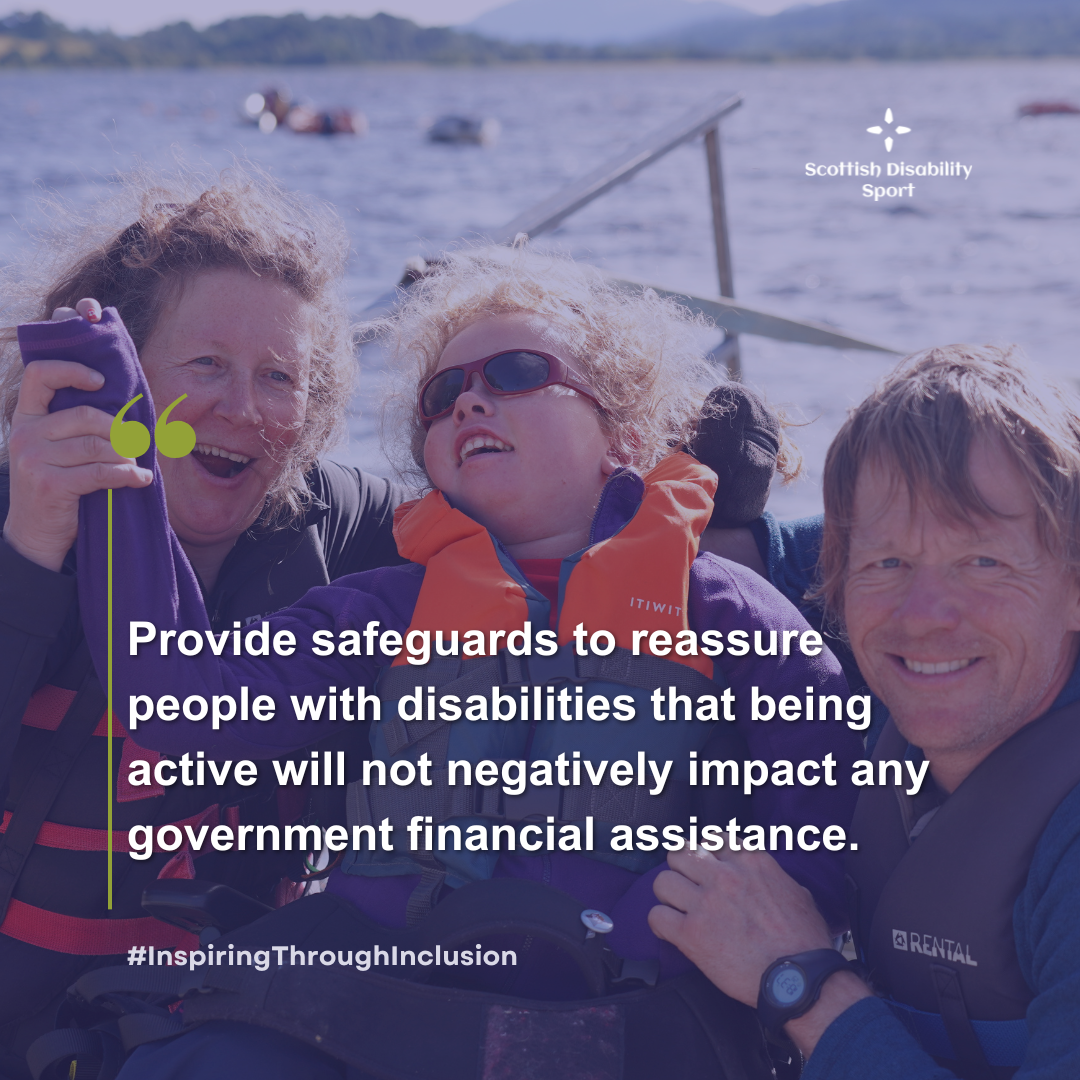
A major barrier that continues to be impactful for people with disabilities in Scotland is the lack of clear guidance and robust policy to reassure people with disabilities that being active will not affect their government financial support they rely on so heavily to just live. We are hearing anecdotally that the move from the UK system to Social Security System appears to have generally gone smoothly and on the face of it is a more compassionate and supportive system, however, more needs to be done to ensure people are not penalised for engaging in efforts to improve their health. Current benefit rules and systems can discourage participation and engagement in sport and physical activity. Although Self Directed Support is designed to prioritise choice and control, inconsistent implementation around accessing physical activity is limiting these choices. Physical activity should be seen as a critical and substantial need for individuals to allow them the freedom to pursue health and wellbeing gains. It has been proven that it can cost an average of £1100 a month more to have a disability than to not, clearly difficult choices need to be made for individuals for the most basic of needs before determining whether expensive sporting opportunities are accessible to them. This is why we back a mandated inclusive strategy where all bodies who receive any public funding ensure that they are accountable for providing affordable and accessible opportunities for people with disabilities and furthermore provide a discounted rate to participate.

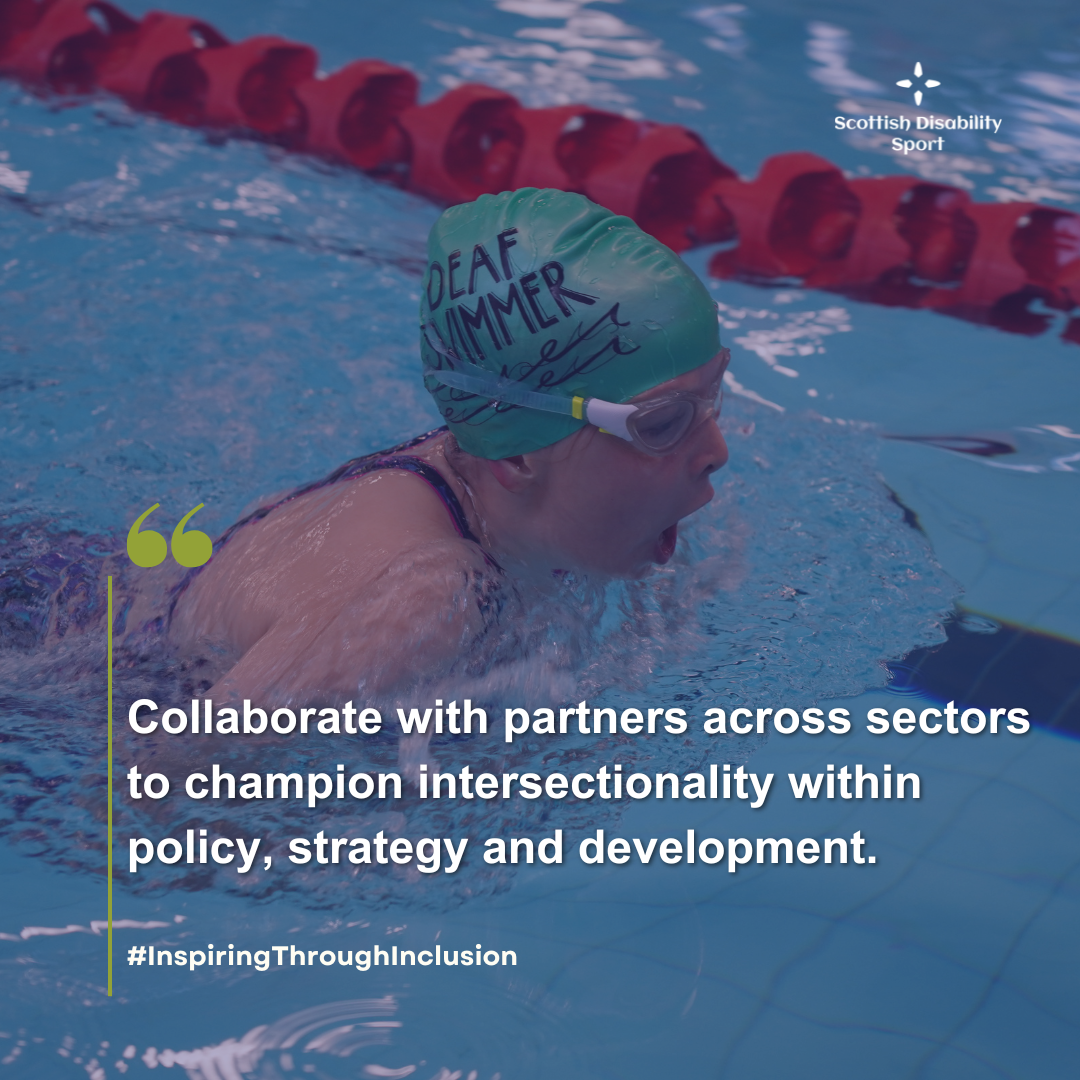
Finally, people with disabilities must be at the heart of decision‑making. Policies designed for People with disabilities too often fail because they are not designed with them. Co‑design is not a buzzword; it is a necessity. People with disabilities are experts in their own lives, and their voices must shape facilities, programmes and policy from the outset. At SDS we talk about taking an intersectional approach to inclusion. But what does this mean? Essentially, it means that we know that people are not made up of one characteristic alone, individuals have many identities – and these very identities can layer multiple and varied barriers to being active. One-size-fits-all approaches will often miss key needs. Collaboration with informed organisations, individuals and co-design will benefit future policy and planning.

This election presents a clear test. Parties across the political spectrum will talk about prevention, wellbeing and tackling health inequalities. The question is whether they are prepared to act when it comes to people with disabilities’ right to be active. Platitudes are not enough. What we need are clear pledges aligned with the SDS Call to Action, setting out how the next government will reduce barriers, close participation gaps and deliver lasting change.

Scotland has the talent, the evidence and the infrastructure to lead the way on inclusive sport. What has been lacking is the political will to treat this issue with the urgency it deserves. If we get this right, the rewards will be felt far beyond sports halls, playing fields and leisure centres—improving health, strengthening communities and affirming the value of people with disabilities’ participation in every aspect of Scottish life.

As voters prepare to make their choice, I urge them to ask a simple question of those seeking office: Will you turn inclusion into action? For People with disabilities across Scotland, the answer cannot be postponed any longer.

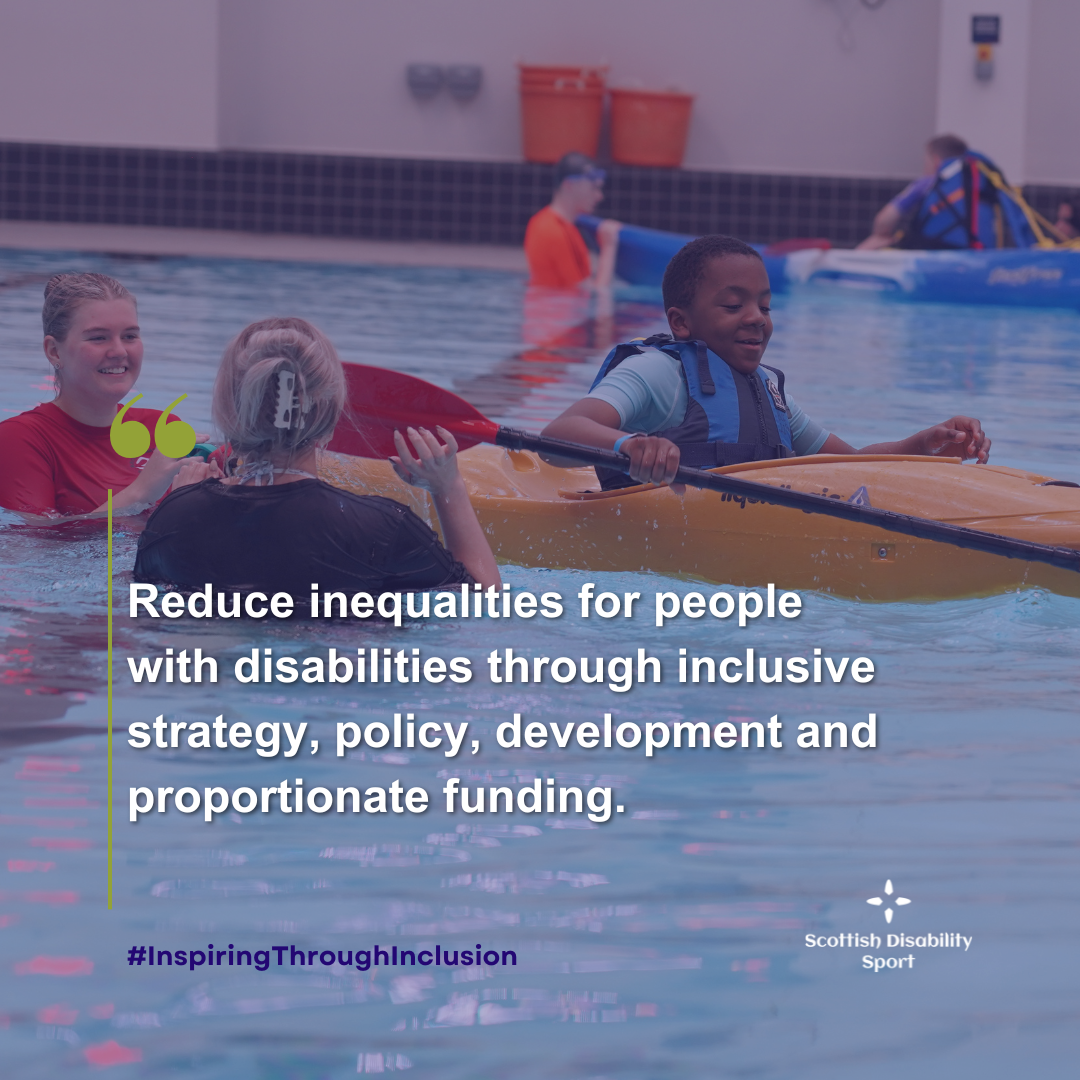
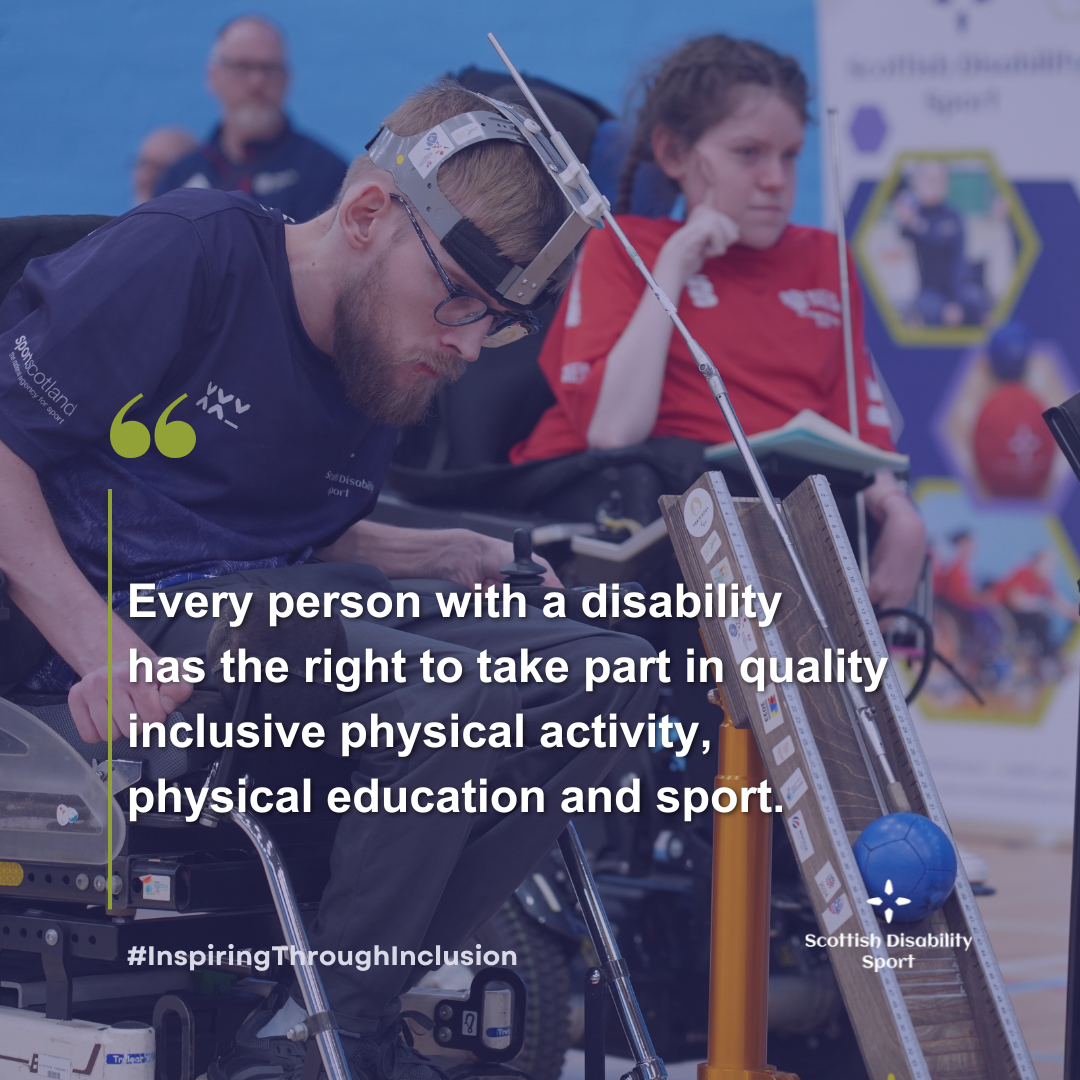
The SDS four-point Call to Action Graphics are available to download via the links below: 

Tomorrow, Mark will take us through a summary of each of the main party manifestos and what they mean for people with disabilities in Scotland.

Alex Medley about to throw a boccia ball overarm.

National Boccia Squad Confirmed

With Returning Talent and New Additions 

Scottish Disability Sport (SDS) is the recognised governing body for the sport of Boccia in Scotland and is tasked with developing players capable of domestic and international success. SDS is also responsible for progressing the best Scottish talent to a UK Boccia World Class Programme where players represent Great Britain at European, World and Paralympic level.  In order to achieve this, a competitive national squad is a vital element.  

After the selection process, 8 players have been re-selected onto the squad after a successful 2025 season. They are being joined by two new players, Layla McCloskey (East Renfrewshire) and Rachael Page (Fife), who have impressed in the 2025 year with their recent results and long-term potential.  SDS is also delighted to have coaches Claire Morrison, Jenny Nethery and Peter McGuire coaching the national squad.  

Please see the squad selection below – 


Players 
 

Name  Classification  Local Authority  SDS Branch 
Alex Medley  BC1  Perth and Kinross  Perth and Kinross Disability Sport 
Kayleigh Brown  BC2  South Ayrshire  Ayrshire Sportsability 
Layla McCloskey  BC2  East Renfrewshire  Disability Sport Glasgow 
Rachael Page  BC2  Fife  Disability Sport Fife 
Patrick Wilson  BC3  City of Edinburgh  Lothian Disability Sport 
Fiona Muirhead  BC4  South Lanarkshire  South Lanarkshire Disability Sport 
Paul McIntyre  BC4  Stirling  Forth Valley Disability Sport 
Scott McIntyre  BC4  Stirling  Forth Valley Disability Sport 
Stephen McGuire (MBE)  BC4  South Lanarkshire  South Lanarkshire Disability Sport 
Tyler McLelland  BC4  Fife  Disability Sport Fife 
Meredith Greenwood  Ramp Operator (Patrick Wilson)  City of London   


Coaches 
 

Name  Local Authority 
Claire Morrison  Fife 
Jenny Nethery   Renfrewshire 
Peter McGuire  South Lanarkshire 


If you would like to find it any more information, please contact SDS’s Performance Development Lead and Boccia Development Officer, Jonathan Kennedy on email: Jonathan.Kennedy@scottishdisabilitysport, or call: 0131 317 1130


Latest News can be found here: Latest News Latest News. 


Jim Anderson celebrates on the podium at the Athens 2004 Paralympic Games. He has a wearing Laurel wreath on his head, his gold medal around his neck and his arms are out to the side in triumph. He is holding a bouquet in his right hand. He is sitting in his wheelchair and a woman claps in the background.

The Power of Sport: Jim Anderson’s Story

By William Moncrieff, Communications Officer 

Since taking up sport in the 1970’s, Jim Anderson OBE has made himself a household name throughout the Scottish sporting landscape. Jim’s incredible career saw him compete in swimming at a staggering six Paralympic Games, where he had great success, earning him the affectionate nickname of ‘Jim the Swim’. 

Jim’s swimming career spanned two decades, where he competed against some of the best in the business, filling up an impressive trophy cabinet in the process. Now at the age of 63, Jim hasn’t loss his competitive edge, often taking to the boccia court to show his athletic ability. 

Initially trying sport 50 years ago, it would have been impossible to forecast the lifelong impact that Jim would have on Scottish sport. However, like many athletes Jim didn’t take up sport to be in the spotlight, it was something a lot simpler. 

Growing up with cerebral palsy, sport provided an opportunity of independence and inclusion. He said: “I really enjoyed it, just because I was able to do something.” 

In his twenties, Jim set his goals and ambitions firmly on becoming a Paralympian and at the Barcelona 1992 Summer Paralympic Games, his dreams were answered. Jim wasn’t willing to stop there though, going on to compete in the next five Paralympics, to retire after the London 2012 iteration. 

Throughout his Paralympic career, Jim found himself on the podium a total of 17 times, winning six golds, nine silvers and two bronze medals which all added to his legacy as one of Great Britain’s most prolific swimmers. 

 Undeniably though, Jim’s highlight came at the 2004 Paralympic Games in Athens, when competing in the 50m, 100m and 200m Freestyle S2 and 50m Backstroke S2. He commented: “I am most proud of my four gold medals in Athens, it was great.” 

Arial shot of Jim doing the backstroke during competition at the Athens 2004 Paralympic Games.

Another element of his Paralympic career that Jim looks back on with an immense amount of pride, was managing to perform at the highest level, in  front of those closest to him: his mum and dad – John and Brenda – and brother, Stuart. “To see me on the podium was wonderful for my family,” he said. 

Although Jim no longer finds himself competing in swimming, he has made sure to still stay involved in the sport, saying, “I retired after London 2012, but I am still involved with the Scottish Disabled Swimming Team.”  

Working once a month with some of Scotland’s emerging talent, has been providing Jim with a deep sense of enjoyment as it takes him back to what it first meant to him to be included in sport. One of his favorite elements, is playing a role in developing the next generation of Scottish athletes, saying: “I like helping the new swimmers coming up, it is great.” 

Along with being a keen volunteer in swimming, Jim has been working hard to provide individuals in the east of Scotland with an opportunity to take part in boccia. Helping to found a drop-in session in Broxburn, Jim has opened the door for many individuals to try boccia in a fun, friendly, inclusive and accessible setting. A main reason for starting the club, was because of the incredibly inclusive nature of boccia. Jim wanted to provide as many people as possible with an opportunity to enjoy the sport: “Boccia is great, because anyone can play it,” he said. 

Furthermore, boccia provides Jim with opportunities to get out and compete in sport. He said: “I like that I still get to compete.” 

Jim throws a boccia ball during a game at the Scottish Championships. It is a side-on photo showing Jim in his wheelchair - which has a yellow frame -  wearing a blue fleece with a bright red bag around his shoulder that sits on his lap. He has white hair and wears glasses. 


Having received countless accolades and winning a total of 57 medals across the Paralympic Games, World and European Championships, Jim is a great role model in sport – showcases what is possible if you have a disability.  

Being a role model is something that Jim is extremely proud of, for it: “makes people realise that they can do it, and that nothing is a barrier,” Jim said. 

To find out all about the sport and physical activities in sport within your local area and community, reach out to your Regional Development Manager.  

To keep up to date with all things disability sport across Scotland, follow Scottish Disability Sport on FacebookInstagram and LinkedIn

Fiona Muirhead with her award from the Boccia Challenger 2026

Scottish Athletes Shine at DSNI Boccia Challenger in Antrim 

By Jonathan Kennedy

Scottish Disability Sport (SDS) is delighted to celebrate the outstanding performances of three national squad athletes who competed at the DSNI Boccia Challenger in Antrim, 6th – 8th the March 2026. All three players delivered impressive results and represented Scotland with distinction throughout the event. 

In the BC4 category, Fiona Muirhead produced a standout performance characterised by consistency, composure, and determination. With the event played in a round robin format, the competition came down to the final match, where Fiona faced Penny Froude of Boccia England in a decisive showdown for the top medals. After a tense and keenly contested match, Fiona secured a 3–2 victory, claiming the gold medal and marking a fantastic start to their 2026 campaign. 

In the BC1 category, Alex Medley competed in an exceptionally close and competitive field. Despite delivering high quality play throughout the round-robin stages, Alex narrowly missed a podium position, finishing in 4th place. 

Layla McCloskey was the third member representing SDS where she competed in the BC2 category. This was Layla’s first event competition as a member of the SDS National Boccia Squad. Building on strong momentum after finishing 2025 on a high at the UK Boccia Championships, Layla continued her impressive play by reaching the 5th/6th playoff matches in a highly competitive field. 

Squad group photo, consisting of (from left to right) Peter McGuire, Layla McCloskey, coach Claire Morrison, Fiona Muirhead, SDS boccia development officer Jonathan Kennedy, Alex Medley. They are all looking to the camera and smiling. Peter, Fiona and Alex are in their wheelchairs, Layla is sitting on her frame whilst hugging Claire. Claire and Jonathan are standing up.


The DSNI Boccia Challenger offered invaluable experience for all three Scottish athletes as they continue their progression within the national programme. Performances of this calibre help build important momentum as they embark on their 2026 season. A big thank you to Disability Sport NI for hosting the event.  

SDS is the national governing body for Boccia in Scotland and is dedicated to the growth and success of the sport at all levels. 

If you are interested to learn more about boccia and your local opportunities, please contact Jonathan Kennedy, the Boccia Development Officer, via email on Jonathan.Kennedy@Scottishdisabilitysport.com; or call on 07830158253.  

Two families playing boccia together. There are two young girls in wheelchairs using boccia ramps and two mums and one dad.

Boccia Brings Families Together During Bespoke Family Day

Scottish Disability Sport (SDS) hosted its first ever Family in Boccia Day which proved to be a resounding success, on Saturday 21st February supported by Shepherd Chartered Surveyors 

SDS’s Boccia Development Manager, Jonathan Kennedy, organised the event which aimed to create an opportunity for families to come together, try and play boccia in a non-competitive environment.  

Jonathan said, “It is great to see so many young people and their family attend this event. The Family Boccia Days are all about introducing new young people and their family to boccia and enjoying themselves. Letting them experience the sport and signpost them to their local club or session if they want to play more.” 

He continued to say: “Today, some of the deliverers are local coaches who have already linked in with the participants and their family about attending their local boccia session which is what this day is all about.” 

The Family in Boccia Day allowed for families in central Scotland who had a child under 18 years-old with a physical disability as their main disability, to learn about boccia, practice skills and play some fun games with other families.  

For many children with a disability that attend a mainstream school in Scotland, their access to physical education (P.E) is limited. This has so far been the experience for 6-year-old Amber, according to her mum Leanne, who attended the Family in Boccia Day. 

“We find it really hard to find activities for her to do that are suitable for her”, said Leanne, who further commented: “In school she gets taken out when her class are doing P.E, when they’re doing gymnastics or other stuff that she’s unable to do, so this upsets her a lot. So having sports that she is able to do is just great.”  

The event also provided Amber to socialise with other children with a disability: “Because she is in mainstream (school) it’s really good for her to be around other kids who are in a wheelchair, just like herself. It’s perfect, it’s ideal.” 

Amber was an enthusiastic participant throughout the day, with Leanne remarking that: “I think this will be really good for her confidence, to do a sport that she’s also really good at.” 

Boccia is a fantastic sport in bringing people together. It is the most inclusive sport that there is and this accessibility aspect did not go unnoticed.  

Thomas, father of Ethan, said: “I thought it (Family in Boccia Day) was brilliant because of the accessibility aspect and the ramps because Ethan doesn’t have a lot of mobility, so it’s good for kids of all disabilities. People with mobility issues are able to play so it’s great.” 

Ethan thoroughly enjoyed the day, commenting: “It was really fun and the social interaction was fun, we had a laugh. It was all good.” 

Furthermore, the day proved to provide a welcoming environment for all. Participant Michael was quite anxious ahead of the day but his mum, Mary, said the relaxed setting prevented Michael from feeling overwhelmed and supported him to take part.  

Mary said, “When he first walked in he (Michael) liked the atmosphere in the hall – the fact that he could wander about and he wasn’t ‘stuck’ somewhere before it started. Also, the games, they’re just so accessible. Sometimes when he plays things he can’t pick it up quickly and he finds that quite difficult and disheartening. Whereas today, he was able to do it and was scoring points.” 

The social aspect of the sport plays a huge part within the boccia community and contributes greatly to player satisfaction and emotional health and wellbeing. Thomas commented on this, saying: Thomas: “The social aspect is really, really good because every kid is having fun and the time just flies by.” 

The opportunity for families to connect was appreciated throughout the day.  

Amber’s mum said, “It’s good for them (Amber and her sister) to play this sport together because her sister goes to dance and gymnastics and so again, Amber gets upset that she can’t do that and so this is nice that they can do this together.”  

Ross, a young boy with cerebral palsy, was joined on the day by his mum and brother. His mum, Fiona, said: “He’s really enjoyed it. It’s something that the boys can do together and that’s great. There isn’t really a lot of things that they can do together and we three always come as a family.” 

Next month (May) is set to host the second Family in Boccia Day in Moray, targeting families based in the north of Scotland. If you would like to register for this event, you can do so via the link below. 
For more information about how to get involved in boccia in your local community, please contact: Jonathan.Kennedy@scottishdisabilitysport.com or call on: 0131 317 1130.  

An image of Rachael Page, wearing a red Disability Sport Fife top next to Claire Morrison, the Performance Coach from Boccia UK in a game hall. Both are smiling for the photograph.

Women and Girls in Boccia: Rachael Page’s Story

By William Moncrieff, Communications Officer

Rachael Page started playing boccia around 10 years ago, through one of Scottish Disability Sport’s (SDS’s) member branches, Disability Sport – Fife. She started playing boccia as a means to meet new people, play a new sport and experience the benefits that come with getting physically active. Rachael has cerebral palsy which affects all four of her limbs and so boccia provided the ideal opportunity for achieving the above.

It wasn’t long though until Rachael realised that she wanted to play boccia in a competitive environment: “I have wanted to play boccia competitively since I was a wee girl when I was still at high school. I absolutely love my boccia,” she said.

Alongside playing weekly in Glenrothes, Rachael also trains alongside the Tayside regional team. This has resulted in her being coached by some of the best available coaches, such as Darren and Sam Thompson.  Rachael remarked on how this has positively impacted her, “They’ve been brilliant, they really have. It’s good as it is showing me loads of things, for example how to throw the balls with different techniques.”

All of Rachael’s hard work and commitment to her craft, came to fruition in early 2026, as she won Senior Sportsperson of the Year at Disability Sport – Fife’s awards ceremony. She reflected on this achievement: “To have been selected for the national Boccia Squad, and to win this award, I’m just over the moon, it’s a great way to start the year.”

One of Rachael’s favorite elements of the game is the social aspect, allowing her to meet and socialise with new groups “I enjoy it and it’s a good way of socialising and making friends with new people,” Rachael said.

The impact of role models is something that Rachael has started to notice recently.

Rachael told SDS that: “My goals are to follow in the footsteps of Kayleigh Brown.”

She believes that Kayleigh is a fantastic ambassador for the sport. “I think Kayleigh is a great role model because she has a great personality and is a great player.”

In 2025, Rachael was successfully classified as a BC2 athlete. This along with her consistent levels of performance has resulted in her being selected to be part of the Scottish National Boccia Squad in 2026. This resulted in her attending a training camp that was hosted in Sportscotland’s National Centre Inverclyde. Rachael really enjoyed her experiences with the squad, and can already see it impacting her positively “It was an amazing experience, I learnt a lot in terms of my posture when throwing the ball.” Said Rachael. Alongwith the training camp providing Rachael with opportunities to develop on the court, Rachael enjoyed having an opportunity to meet other members of the squad, including her role model Kayleigh Brown “I got the chance to eventually meet Kayleigh, and we got the chance to play each other in our drills. She is amazing, and to see how she plays, obviously I have a long way to go, but it just shows where I could end up.” Rachel explained.

Along with having her own role models, Rachael feels strongly about the importance of female role models to inspire the next generation of women and girls, commenting: “I think it’s important to have more female role models in boccia because there aren’t many females that compete in boccia and I think that it would be great to see more females play competitively in boccia as well.”

Rachael has learnt first-hand how boccia can help people to overcome barriers “You can never say no to anyone from boccia. It’s amazing what people can do, it really is.”

Rachael has become extremely grateful for all of her experiences; from training weekly and regionally to taking part in events and making friends.

“A lot of these things are things I didn’t think I would do and I am really grateful for the opportunities that I have had.”

If you like the sound of some of the experiences that Rachael has had, and you would be interested in trying out boccia, contact SDS’s Boccia Development Officer on: jonathan.kennedy@scottishdisabilitysport.com to find out what opportunities there are to take part in the sport as a player, volunteer, coach or official.

To keep up to date with all things disability sport across Scotland, follow Scottish Disability Sport on Facebook, Instagram and LinkedIn.


Photo of a young girl in an electric wheelchair playing boccia. She is wearing a boccia cap with head pointer.

National Boccia Training Camp 2026 Recap

Largs played host to the National Boccia Training Camp, which was held earlier this month (13th to 15th February) at sportscotland National Sports Training Centre Inverclyde.  

Attending the camp were seven national players plus one development player from Scotland, as well as five players and a couple coaches from Disability Sport Norther Ireland (DSNI).  

The camp kicked off on the Friday with a ‘connections and culture’ workshop. This allowed for the new squad members to hear from the more experienced players about the impact and involvement of being in the squad, followed by the opportunity to discuss player’s aspirations.  

This was followed by a two-hour long skills session with DSNI.  

The Saturday was a jampacked day of training from 9am to 6pm, divided into a morning and afternoon session. Players were separated into small groups of mixed classifications and squads. This allowed players to learn from each other, share insights and tips and gain an understanding of the different skills required per player.  

Each group also had access to a selection of coaches from both Scottish Disability Sport (SDS) and DSNI.  

Scottish squad member, Fiona Muirhead, commented on the day saying: “Having coaches and athletes from Northern Ireland has provided a good opportunity to play against new players, particularly those we don’t play often, it was also good to engage with new coaches and different coaching styles. It just gives us a bit more variety and an opportunity to push ourselves more.”   

Fiona Muirhead playing boccia. She is wearing her Scottish boccia kit and in her electric wheelchair.


After the intense day of training on Saturday, the evening’s entertainment involved a quiz and music bingo – it was quite the social affair!  

Sunday provided players with the opportunity to put their learning from Saturday to the test, with games played from 9am to 12noon in proper matchday format.  

SDS’ Boccia Development Officer, Jonathan Kennedy, regarded the camp a big success. He said, “It was fantastic to have a joint camp with players and coaches from DSNI. 

“I feel the camp is invaluable to everyone who attended as everyone can share their knowledge and experience and as a result support player and coach development. 

“This joint camp, which has been done for a few years now, allowed for close partnership working between both SDS and DSNI. The set up supports players across the national squad pathway through to those on the world class programme and I believe it is a unique set up that we have with both countries playing a part in shaping the camp.” 

He continued to say: “It was also great to see young up and coming development players attending with their coaches to work with the other coaches and players both in gaining information but sharing their knowledge and experience. ” 

Fiona added to this, saying: “The Scottish Camp always has such a lovely atmosphere. It was really exciting to see the new faces, particularly the new female faces joining the group.” 

Reflecting on the weekend, Scottish and Boccia UK Performance coach, Claire Morrison, said: “It is always great to get our Scottish Squad players together for an intensive couple of days training and matchplay. 

“Having the opportunity to work alongside our friends from Northern Ireland also brings a different dimension and variety to our work. It is a really important way to start the season both technically and from a connectivity perspective. 

“There is a great mix of experience and youth in the group of players and I love to see how they work together and support each other to learn and have fun in this environment.” 

Photo of a young man in his wheelchair with red and blue boccia balls. He is wearing a green Northern Ireland boccia training kit.


If you would like to find out more about boccia and how you can get involved as a player, official, volunteer, coach, education practitioner, please get in contact with SDS’ boccia development manager at: jonathan.kennedy@sottishdisabilitysport.co.uk or call: 0131 317 1130 

To find out how you can get involved in disability sport throughout your area as a participant, coach, official or volunteer, contact your Regional Development Manager

To keep up to date with all things disability sport across Scotland, follow Scottish Disability Sport on FacebookInstagram and LinkedIn

profile photo of Grace Stirling. Grace is smiling to the camera and is wearing a brown jacket and tartan scarf. A lake and Scottish hills are in the background

Grace Stirling Rejoins SDS Family in New Role

Scottish Disability Sport (SDS) is delighted to welcome Grace Stirling in a new role at SDS, as Disability Identity and Sport Developer. 

Grace returns to SDS after working as the Young Persons’ Sport Panel (YPSP) Administrator (2023-2024) and before that, sitting on the panel herself. We caught up with Grace to find out all about this new and exciting opportunity. 


Question: Can you tell us about your new role and responsibilities? 

I’m very excited to be returning to SDS as the Disability Identity and Sport Developer. I was part of the original group of young people who created the Disability, Identity and Sport workshop, and I’ve supported its delivery ever since. We’ll continue to run the original workshop, and I’m keen to reach even more young disabled people and other audiences too.

In my new role, I’ll also be supporting the current YPSP and Young Start members to design and deliver a new workshop on disability advocacy. Having had the chance as a young person to shape a workshop myself, I know how important lived experience is in creating something meaningful and relevant.

Now, I’m excited to see the current members take the lead. Advocacy is such an important part of life with a disability, yet there are few places for young people to learn and build this skill. The young people have highlighted it as a topic they’re passionate about, and I’m looking forward to helping them use their experiences to bring this new workshop to life.


What does this new role mean for you? 

Returning to SDS feels really special to me. It’s an organisation where I’ve grown a lot, built my confidence, and felt genuinely listened to as a young disabled person. Now being able to support other young people to have those same experiences means a lot to me.


What are you ambitions within this role?

My main ambition in this role is to make sure the workshops reach as many people as possible, especially the young people who need them most. It’s also really important to me that disabled young people get the chance to use their voices and lived experience to educate and influence those who work with disabled young people and those who work in sport and that the learning from these workshops has a lasting impact on practice. 


Welcome back, Grace! 

Photo of the SDS events team, from left Kirsty, Charlotte and Josh.

My Time as the Young Start Events’ Assistant

A Year of Empowerment and Inclusion with Scottish Disability Sport

By Charlotte Askham

For me, the past year has been nothing short of transformative. As the Young Start Events Assistant with Scottish Disability Sport (SDS), I has played a vital role in delivering inclusive sporting events across the country, supporting athletes with physical disabilities, learning disabilities, vision impairments and hearing loss.

Josh and Kirsty smiling to the camera as they are sitting at a registration desk for a SDS event

“I am incredibly grateful to SDS, Josh, and Kirsty for this amazing opportunity,” Charlotte shared. “It’s been a year of growth, learning, and unforgettable experiences.”

From swimming competitions to boccia tournaments, I have taken on a variety of responsibilities including registration, social media and results coordination. These hands-on roles have helped my build confidence and gain valuable insights into event logistics and team collaboration.

One standout moment was the national Summer Camp held in Aviemore—a three-day event for young athletes aged 10 to 17. “Supporting my team and watching them push past boundaries was incredibly inspiring,”. “And yes—our team won! Go greens!”

Charlotte and the staff from the green team at the SDS summer camp


Reflecting on my journey, I highlighted the diverse skill that I have developed, from communication and teamwork to event planning. My time with SDS has laid a strong foundation for future opportunities in sport and community engagement.

This story is a testament to the power of inclusive sport and the impact of youth development programs. As I looks ahead, her passion and experience promise to make waves in whatever comes next.

Photo of Kirsty and Charlotte together. Kirsty is wearin a SDS top whilst Charlotte is wearing a red blouse

A massive thank you to the National Lottery Young Start Funding for providing this opportunity of a role within SDS.


The setting is a large meeting room with two sets of windows looking out to a bright exterior. A large screen to the rear of the room is displaying the SDS 4-point Call to Action.  There are tables and chairs round the perimeter There are three groups of peoples sitting at round tables and participating in discussions. The main table in the foreground of the picture features eleven people with a mixture of ages, genders and roles which include coaches, volunteers, athletes and staff and board members.

Scottish Disability Sport Seeks Members for National Advisory Forum

YOUR SPORT. YOUR VOICE. YOUR IMPACT

• Are you passionate about shaping the future of disability sport in Scotland?
• Do you have lived experience of disability and want to make a difference?

Join the National Advisory Forum at Scottish Disability Sport – a dynamic group of individuals who bring real-world insight, experience, and ideas to influence positive change.

Type of role: Voluntary
Commitment: 4 meetings per year (mainly online with occasional in-person)
Duration: 2-year term with the possibility to serve for a further term
Reporting to: SDS Governance Subgroup
SDS Liaison: SDS Head of Policy
Deadline: 12pm, 4 February 2026
Interviews: Week beginning 9 February 2026 (Time TBC)

Scottish Disability Sport (SDS) is fully committed to being an organisation that co-designs with our athletes and participants to ensure the voice of those with lived experience is heard and directs the work of the organisation. SDS is particularly keen to ensure all disability groups and backgrounds are represented on the forum. Any reasonable adjustments required throughout the application process and for the duration of the forum will be met.


This is your chance to:

  • Advocate for inclusion and equality in sport and physical activity,
  • Advise on policies and programmes that matter,
  • Inspire the next generation of athletes and participants.

Your perspective matters. Together, we can create a sporting landscape where everyone
belongs. Our strategic plan, which directs our work, can be found on our website at
www.scotishdisabilitysport.com alongside our Call to Action which urges all our stakeholders to engage in meaningful change to remove barriers to sport and physical activity.

To apply, please submit a one-page cover letter or 1 minute video indicating your suitability for the role to: Mark Gaffney, SDS Head of Policy at: mark.gaffney@scottishdisabilitysport.com by 12pm on 4 February 2026.

If you would like an informal chat about the role, please contact Mark at the email above or by phoning 0131 317 1130.